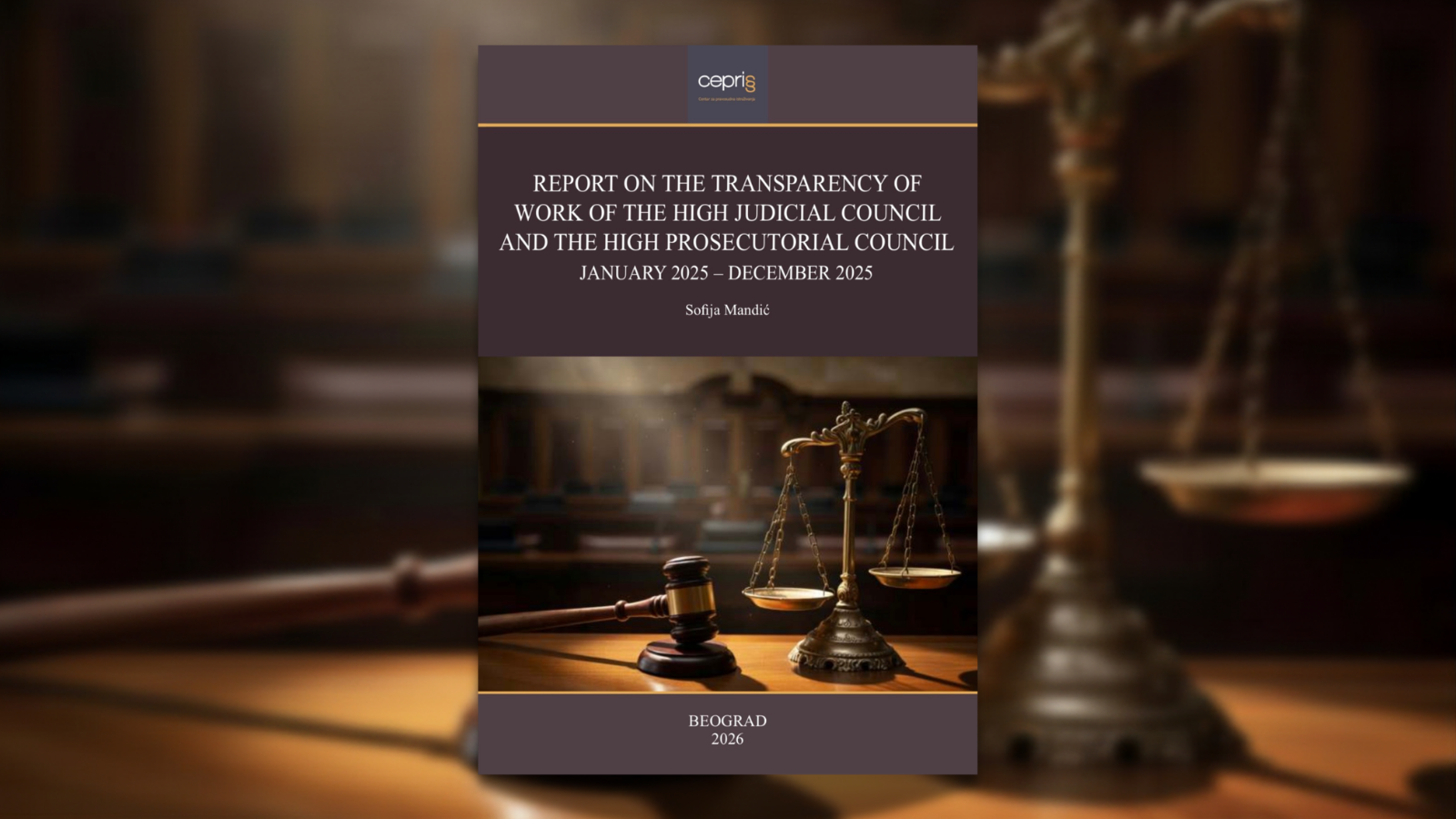
Foto: CEPRIS
The Centre for Judicial Research (CEPRIS) is publishing its third consecutive report on the transparency of the work of the High Judicial Council (HJC) and the High Prosecutorial Council (HPC), covering the period from January to December 2025. The author of the report is Sofija Mandić, lawyer and Executive Director of CEPRIS.
The report was prepared in the context of heightened public interest in the work of the judiciary, which was at the center of public debate throughout 2025. Numerous civic protests calling for the establishment of the rule of law further drew attention to the role of judicial institutions and their governing bodies. In such circumstances, the transparency and openness of judicial councils are key to strengthening public trust in the judiciary.
Accordingly, unlike in previous years, the report notes increased interest from both the media and the public in the work of the HJC and the HPC, indicating that the public is increasingly assuming the role of an important oversight mechanism. However, it remains an open question whether this level of interest reflects the regular development of democratic standards or is a reaction to pressures and attacks by the executive branch on judicial institutions.
CEPRIS’s analysis shows that certain improvements in transparency have been achieved—particularly with regard to the publication of audio-visual recordings of sessions and greater accessibility of certain information. At the same time, the report points to numerous systemic shortcomings that recur year after year.
Key findings of the report include:
- insufficient availability of information on the work and composition of the judicial councils and their working bodies;
- failure to publish materials on the basis of which decisions are made;
- limited and inconsistent openness of sessions, particularly when sessions are held electronically and/or by telephone;
- lack of clear and proactive communication with the media and the public;
- formal rather than substantive reporting on activities, without analysis of the achievement of objectives and the impact of the councils’ work;
- underdeveloped mechanisms for protection against undue influence and their low visibility in the public sphere.
Of particular concern is the growing number of sessions held electronically or by telephone, which effectively narrows the space for public access. In addition, decisions on the appointment of judges and prosecutors remain insufficiently reasoned, making it difficult to understand the criteria for decision-making and negatively affecting perceptions of fairness.
Although the normative framework governing transparency has been improved, practice shows that existing mechanisms are not used to their full potential. Transparency is often reduced to the formal fulfilment of obligations, without genuinely opening institutions to the public.
CEPRIS concludes that further improvements in the transparency of the work of the judicial councils are necessary, including the consistent publication of all relevant information, enhancement of the quality of reporting, reduced use of electronic and telephone sessions in situations requiring public debate, establishment of continuous communication with the public, and strengthening of mechanisms for protection against undue influence.
Improving the transparency of the HJC and the HPC is an important step toward strengthening judicial accountability and building public trust—one of the key prerequisites for establishing the rule of law in Serbia.
****
During the presentation of the Report, it was noted that the recommendations to publish the names of public prosecutors, as well as the biographies and photographs of the members of the High Prosecutorial Council, and to publish part of the materials from electronic sessions, have in the meantime been fulfilled.
 Loading...

 Reload document
  Open in new tab
Ostavite komentar